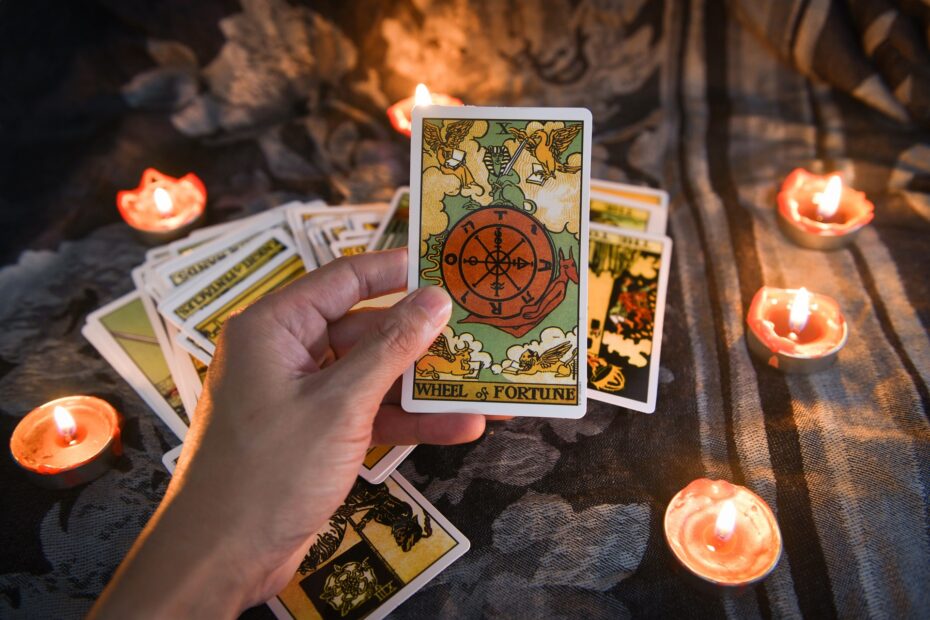
If you look at the Tarot cards and their images. I am sure that you will feel a strange connection. And people around the world for hundreds of years have been mystified with curiosity by those strange images in every Tarot card. And those cards have been the reason that many people found answers to their problems or questions about their lives. But they didn’t start that way as it is now at all.
Let’s go back to where it all began. The story is longer—and more surprising—than most people think.
The Beginning
When it first started the Tarot did not begin as a fortune-telling tool. Tarot was just a card game which was played by rich people around the year 1400s in Italy. The first written mentions of tarot packs showed up between 1440 and 1450 in northern Italy. And mostly in places like Milan and Ferrara.
These early cards were called “carte da trionfi” or triumph cards. The special picture cards eventually became known as “trumps” in English. One of the oldest references to tarot appears around 1450-1470. And this was when a Dominican preacher complained about them in a sermon. He was upset about dice, playing cards and these new “triumphs.”
And for about 300 years the tarot cards were just for games. Nobody was using them to tell fortunes or connect with spiritual things. And they were just like any ordinary playing cards which the nobility at that time used to enjoy.
The Big Shift
But everything started to change in and around the years 1700s. A French clergyman saw some women playing with tarot cards. His name was Antoine Court de Gébelin. Suddenly he got an idea. He had a strong belief that those cards origin was influenced from ancient Egypt. He also believes that those cards represent the ancient wisdom.
And in the year 1781 he started to published his ideas. He claimed that tarot represented the ancient Egyptian theology. And in this theology, there were mentions of ancient gods like Isis and Osiris. He even came up with a fake history. He claimed that the word “Tarot” came from Egyptian words which means “the Royal Road of Life.”
But the truth is that most of his claimed are not proven and had no facts in it. But many people begin to love these ideas.
Another Frenchman by the name of Comte de Mellet then took these ideas even further. He was the first to suggest tarot was “The Book of Thoth” and made the first connection between tarot and fortune-telling. Between these two guys they created a whole history that many people still believe today.
Etteilla: The First Tarot Pro
Jean-Baptiste Alliette (who called himself “Etteilla” by spelling his name backwards) became the first professional tarot card reader in 1783.
He made the first tarot deck specifically for fortune-telling. And he wrote books about tarot meanings. He even started the first tarot society with the name “Société littéraire des associés libres des interprètes du livre de Thot.”
Etteilla published a dictionary of card meanings that listed what each card meant both right-side-up and upside-down. And his ideas caught on and suddenly people were using the cards to peek into the future.
Éliphas Lévi
In the mid-1800s, a former Catholic seminary student named Alphonse-Louis Constant (who used the name Éliphas Lévi) made tarot even more magical. Michael Dummett, a famous tarot historian, said that “the whole of the modern occultist movement stems” from Lévi’s books.
Lévi claimed tarot was “the key of all doctrines and all philosophies of the old world.” And according to him, a person locked in prison with nothing but a tarot deck could gain “universal knowledge” if they knew how to use it properly.
He connected tarot cards to Hebrew letters, astrology and the four elements.
Secret Societies
In the streets of London back in 1888, three men started something that would change tarot forever. William Westcott, Samuel Liddell MacGregor Mathers and William Woodman claimed they discovered ancient documents written in secret code. These papers were called the Cipher Manuscripts. And it supposedly revealed the structure of a lost magical order. They used those documents to create the Hermetic Order of the Golden Dawn.
The Golden Dawn was like a school of magic that studied astrology, alchemy and tarot. They changed some things about tarot that have stuck around:
- They put The Fool at the beginning of the deck
- They swapped the positions of Justice and Strength cards
- They connected each card to different planets, zodiac signs and elements
These changes completely transformed how people understood the cards. The Golden Dawn never released their own public tarot deck but their ideas would soon change everything.
Tarot’s Big Break
Arthur Edward Waite was considered to be one the quiet scholar during the era of the Golden Dawn. He along with another artist by the name of Pamela Colman Smith collaborated to create a new deck. It was in the year 1909 at that time. And they named this deck Rider-Waite-Smith tarot.
And what made this deck so special was that before, only the major cards (like Death, The Lovers, The Fool) had detailed pictures. The number cards were just like the regular playing cards like six cups, nine swords, etc
But Pamela Colman Smith drew full scenes for ALL the cards. And every single card told a unique story. Their work was revolutionary as it made the people to understand the card much better now.
But sadly, Pamela Colman Smith died poor and unrecognized. She created the most famous tarot deck ever as we all know now. Her art has inspired almost every deck that came after.
The Modern Era
In the year 1960s the tarot exploded in popularity. A woman by the name of Eden Gray wrote many books that made tarot accessible to everyone. And It was not just for the occult scholars. Her book “A Complete Guide to the Tarot” from 1970 introduced the idea of the “Fool’s Journey” which was the story of how the major cards represent stages in a person’s life.
The 1970s saw the first artistic and personal decks, like Bea Nettles’ Mountain Dream Tarot from 1975. And they used photographs instead of drawings. By the 1980s and 90s, tarot experts like Mary K. Greer and Rachel Pollack were connecting tarot to psychology and personal growth.
Today there are thousands of different tarot decks. Digital publishing has let artists create decks representing all kinds of communities and perspectives. Tarot has become hugely popular in places like Japan. In Japan hundreds of new decks have been designed.
Using Tarot Today
Now things have changes as most people don’t look at Tarot as a future predicting tool. But they instead now look at Tarot as a tool to find solution and also to point them to the right direction.
There are some people who look at tarot as a connection to the spiritual energies. There are also other that see tarot as a mirror to reflect their own thoughts and feelings. Either way the key is that tarot isn’t about fixed destiny—it’s about gaining insight.